
Polk County Court Records After a Jail Arrest
Polk County is part of Georgia's Tallapoosa Judicial Circuit, so a jail arrest can move through Magistrate Court, Superior Court, and the District Attorney's Office depending on the charge. The Polk County Jail custody record may show a booking date, arresting agency, listed charge, bond, or hold. The court record is the later legal file that tracks whether the accusation became a complaint, accusation, indictment, order, plea, dismissal, nolle prosequi, acquittal, or conviction.
The custody side and the court side should be checked together, but they answer different questions. For roster and booking details, use jail inmate records. For booking-photo context, use jail mugshots. For court records after an arrest, focus on the court office, clerk records, and prosecutor actions because the filed charge may not match the language that appeared at booking.
Access Channels for Court Records After an Arrest
No single official Polk County criminal case-search portal with public inspectable search fields was located in the county materials reviewed. Georgia court records can be fragmented by court, clerk office, case type, and vendor, so the safer path is to use the official Polk County court and prosecutor pages first and then contact the correct office for older files, missing docket entries, or records that are not searchable online.
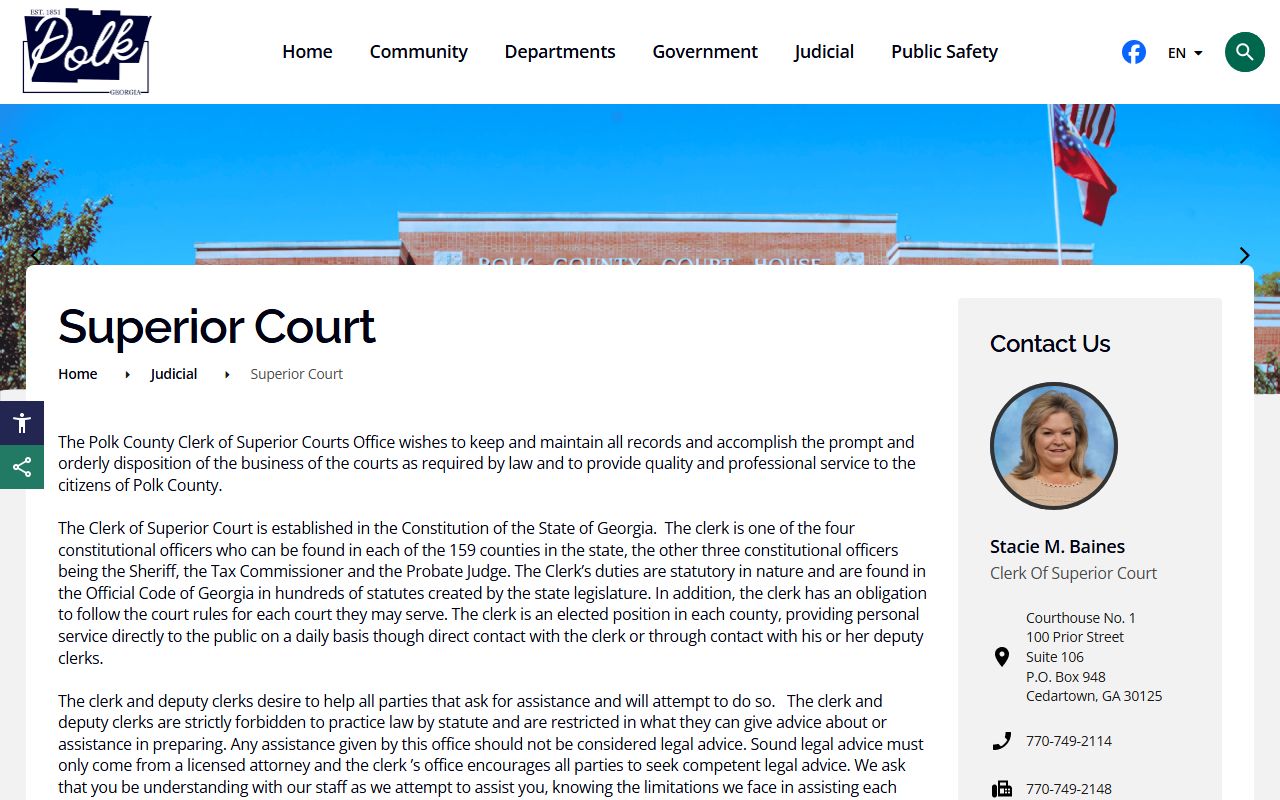
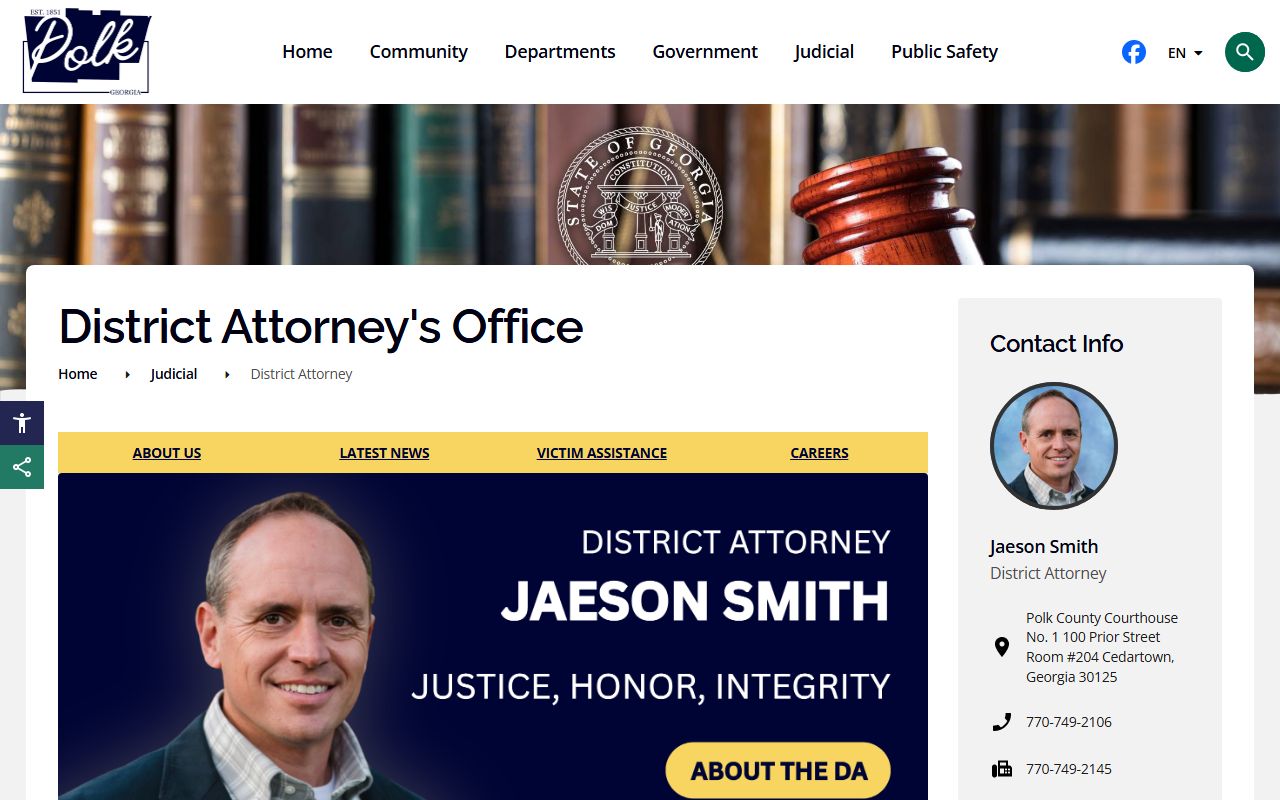
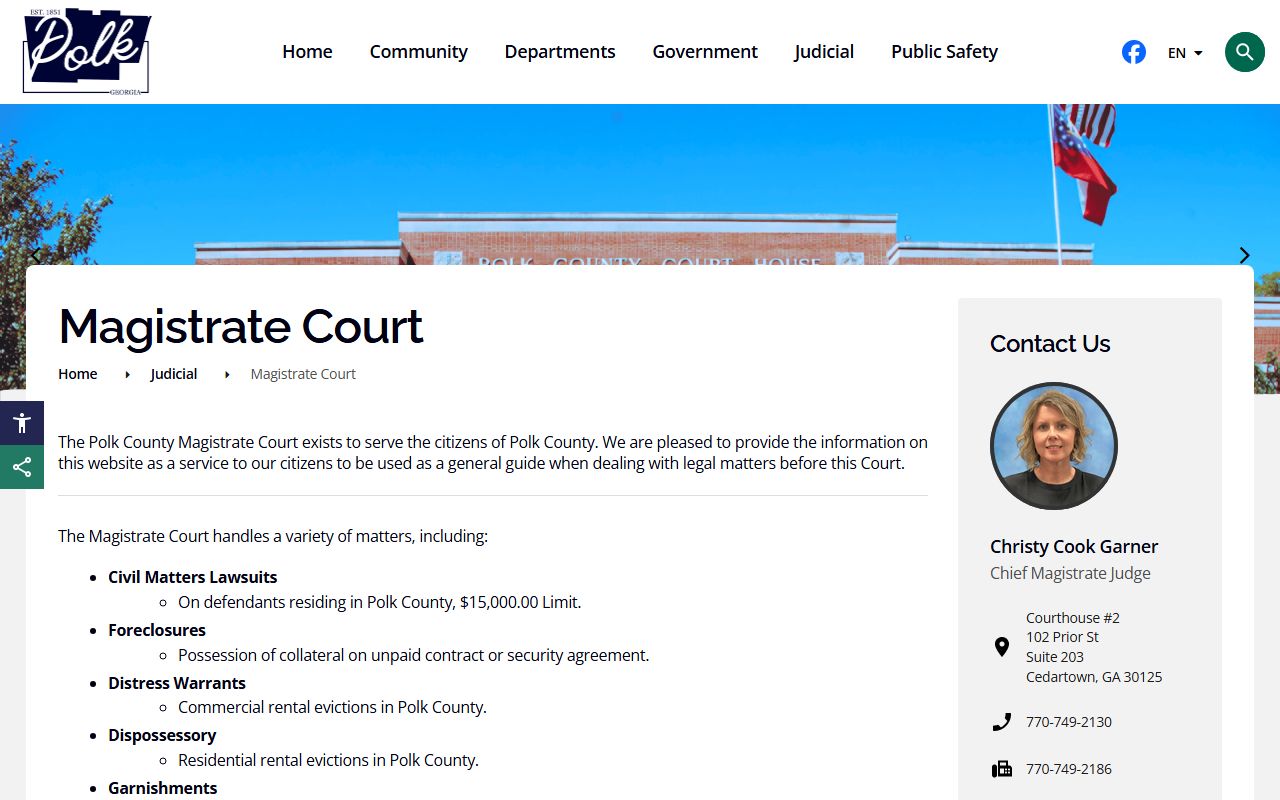
The official Polk County Superior Court page is the starting point for felony-level cases, clerk entries, orders, and court files after a serious jail arrest. The official Magistrate Court page is the local route for warrant, first-appearance, probable-cause, and some lower-court matters. The official Tallapoosa Judicial Circuit District Attorney page identifies the prosecutor's office for state criminal cases in Polk County.
The county's NextRequest open-records portal is useful for sheriff or jail records, but court records often require the clerk or court office instead of the sheriff. For sentenced state-prison custody after conviction, the Georgia Department of Corrections search is a different system. For federal custody, use federal channels such as BOP or U.S. Marshals resources. For immigration custody, ICE ODLS is separate from Polk County court records.
How to Find Polk County Court Records After an Arrest
Start with the arrest-to-court sequence, not with a promise that one web search will show everything. A person may be arrested by the sheriff, Polk County Police, Cedartown Police, Rockmart Police, or another agency, then booked into Polk County Jail. The first public record may be a roster entry. The court record usually becomes clearer after first appearance, bond review, prosecutor screening, and filing in the appropriate court.
- Check the name, booking date, and charge language from the custody record so the court office can distinguish similar names.
- Use the Magistrate Court page for first appearance, warrant, and probable-cause routing.
- Use the Superior Court and Clerk page for felony cases, case numbers, docket entries, orders, and dispositions.
- Use the District Attorney page when the key question is why a charge was filed, reduced, amended, dismissed, or taken to grand jury.
- For sheriff or jail documents outside the court file, use Polk County NextRequest or call the jail at 770-749-2900 before traveling.
When the case record is available, compare defendant name, case number, court, filed charge, statute, charge level, court dates, bond conditions, clerk entries, orders, and disposition. If those fields do not line up with the jail roster, do not assume the roster is the final legal result. The prosecutor and court file control the formal case history.
The official Superior Court and Clerk page is the court-facing source for many case-file questions after a Polk County arrest.
Charging Documents After a Polk County Arrest
After booking, the court case begins with a charging instrument suited to the court and offense. Georgia terminology may vary by case, but the practical point is consistent: a charging document is the court record that moves the case beyond an arrest label. It may reflect a prosecutor's review, a court complaint, an accusation, or a grand-jury indictment. That document can add detail, correct an offense label, change the degree of a charge, or show that prosecutors chose a different path than the booking entry suggested.
| Document | Usually Involved | What It Shows | Why It Matters |
|---|---|---|---|
| Complaint or warrant paperwork | Law enforcement, Magistrate Court, or prosecutor | Probable-cause allegations, warrant basis, initial charge language, and first court handling | Often explains why the person was arrested and how the first appearance or warrant issue reached court |
| Accusation | Prosecutor | Formal charge filed by the State without an indictment where permitted | May differ from the jail roster charge and becomes the working court charge |
| Indictment | Grand jury and District Attorney | Felony charge approved for prosecution after grand-jury presentation | Signals that the case has moved beyond booking into Superior Court prosecution |
| Amended accusation or superseding indictment | District Attorney and court | Changed, added, corrected, or replaced charges | Explains why an early arrest charge no longer matches the active court record |
Charge Status in Court Records After an Arrest
Charge status changes as a case moves. A booking entry may list one charge, while the court file later shows an amended charge, reduced charge, dismissal, nolle prosequi, plea, verdict, or sentence. The Polk County District Attorney, court, and clerk records are the best sources for the final status because law enforcement books an arrest but prosecutors decide what to file or pursue.
| Status | What It Means | What to Check |
|---|---|---|
| Pending | The filed charge remains active and has not reached final disposition. | Next court date, bond conditions, orders, and any motions |
| Amended or reduced | The charge changed from the original arrest or filing language. | Amended accusation, plea paperwork, indictment history, and clerk entries |
| Dismissed | The court or prosecutor ended that charge without a conviction on that count. | Dismissal order, affected charge count, and whether other counts remain |
| Nolle prosequi | The prosecutor chose not to pursue that charge. | DA filing, court order, and whether the same facts appear in another count |
| Convicted | A guilty plea, bench verdict, or jury verdict resulted in conviction. | Sentence, probation terms, jail credit, fines, and transfer to GDC if applicable |
| Acquitted | The defendant was found not guilty on that charge. | Verdict form and final disposition for each count |
District Attorney Review in the Tallapoosa Judicial Circuit
The Polk County prosecutor is the District Attorney for the Tallapoosa Judicial Circuit. The official county page identifies Jaeson Smith as District Attorney and states that he was elected District Attorney for the Tallapoosa Circuit in 2024. The DA's Office represents the State of Georgia in criminal matters in Superior Court and Juvenile Court, works with local, state, and federal law-enforcement agencies, and handles victim and witness services.
This role is central to court records after a jail arrest. A police officer or deputy may enter an arrest charge at booking, but the DA decides whether to file it as charged, reduce it, amend it, decline it, or present it to a grand jury. The DA page also notes that a victim who wants charges dropped must appear in person, complete a request-to-dismiss form, and bring government-issued identification. The ultimate prosecution decision remains with the assigned Assistant District Attorney or DA discretion.
The official Tallapoosa Judicial Circuit District Attorney page for Polk County gives the prosecutor contact point for charging decisions after arrest.
Bond and Release After an Arrest
Bond information for Polk County may appear on the jail roster after a bond is set, but the sheriff page did not publish a local bond fee table, payment-method list, or bond-posting hours in the reviewed materials. Before traveling, call the Polk County Jail at 770-749-2900 to confirm the current bond, accepted payment method, posting location, and whether any holds or detainers block release.
| Bond Type | How It Works |
|---|---|
| Cash bond | The full cash amount is paid to secure release, subject to court rules and the case outcome. |
| Surety bond | A licensed bonding company posts bond for a fee; commercial bail exists in Georgia. |
| Property bond | Property is pledged if court and jail rules allow it. |
| Personal recognizance | The person is released on written promise and conditions without a full cash deposit. |
| No-bond hold | Release is unavailable until a judge or holding agency clears the status. |
Magistrate or first appearance can set or review bond. Felony or serious charges may require Superior Court involvement. Probation matters, parole issues, immigration detainers, out-of-county warrants, or other agency holds can keep a person in custody even when one Polk charge has a bond amount.
Warrants That Lead to Court Records After an Arrest
No standalone official active-warrant search table was located on the Polk County sheriff page during the research pass. For warrant questions, call the sheriff's office or jail at 770-749-2900 and use the correct court office for the warrant type. Magistrate Court commonly connects to arrest warrants, first appearances, and probable-cause handling. Superior Court and the Clerk may be the better route for felony bench warrants, probation revocations, and higher-court cases.
City police or municipal court matters from Cedartown or Rockmart may create city-level bench warrants that are not fully explained by a sheriff web roster. Federal warrants are handled through federal courts and U.S. Marshals channels. Once a person is arrested on a warrant and booked into Polk County Jail, the roster may show a hold, detainer, or agency note instead of a local filed charge. Bond may be unavailable until a judge acts.
The official Polk County Magistrate Court page is relevant when a jail arrest involves warrants, first appearance, probable cause, or initial bond review.
Charges vs. Convictions
An arrest charge is not a conviction. A charge means the person has been accused or formally charged. A conviction means a plea or verdict resolved the charge against the defendant. The distinction is especially important in Polk County court records after a jail arrest because the early roster charge may be broad, incomplete, or later changed by the DA or court.
| Charge | Conviction | |
|---|---|---|
| Stage | Accusation, complaint, warrant, accusation, or indictment | Final result by guilty plea, bench verdict, or jury verdict |
| Proof level | Usually tied to probable cause or prosecutor filing judgment | Requires proof beyond a reasonable doubt or a valid guilty plea |
| Where it appears | Jail roster, warrant materials, DA filing, and court docket | Disposition entry, sentence order, plea paperwork, or verdict |
| Practical meaning | The case may still be pending, amended, dismissed, or not pursued | The charge has resulted in criminal liability and sentence consequences |
Restricted, Sealed, and Expunged Records After an Arrest
Georgia commonly uses record restriction language for eligible criminal-history records, and O.C.G.A. § 35-3-37 is the key restriction, correction, and sealing statute identified in the research. The word expunged is still used casually, but Georgia's public-access question is often whether a record can be restricted from public criminal-history reporting or sealed from public court access. A dismissed charge, nolle prosequi, acquittal, or other eligible disposition does not automatically mean every public trace disappears from every system.
| Restricted or Sealed | Expunged | |
|---|---|---|
| Public visibility | Limited or hidden from public access where the law and order apply | Often understood as removed or treated as though it no longer exists, but Georgia commonly uses restriction terminology |
| Court and agency access | Courts, law enforcement, prosecutors, or authorized agencies may still have limited access | Access depends on the statute, order, and record system involved |
| Typical trigger | Eligible dismissal, nolle prosequi, acquittal, correction, or statutory restriction pathway | Use only if a Georgia statute or order specifically supports that result |
| Where to ask | Clerk, court, prosecutor, GCIC-related process, or attorney depending on the record | The agency or court that controls the record should confirm the available remedy |
Public Access Rules for Court Records After an Arrest
Georgia's Open Records Act, O.C.G.A. § 50-18-70, is the baseline public-record law, but court, jail, juvenile, victim, medical, security, sealed, restricted, and active-investigation records can be treated differently. O.C.G.A. § 42-4-7 relates to sheriff and jailer inmate records. O.C.G.A. § 35-1-19 governs booking photographs in the commercial publication and removal context. O.C.G.A. § 15-11-700 and related juvenile-record provisions are more restrictive than ordinary adult criminal records.
For Polk County, the practical rule is to start with the correct record owner. Use the jail roster or sheriff records path for custody and booking records. Use Magistrate Court, Superior Court, and the Clerk for case records. Use the District Attorney for prosecutor-related questions that the DA office can lawfully address. Use VINELink at https://vinelink.vineapps.com/ for victim or family custody-notification purposes when Georgia and Polk custody data are available.
Background Check Considerations
Casual court-record lookups are not the same as regulated background screening. A Polk County arrest, charge, dismissal, restriction, or conviction must be interpreted through the official case file and the law that governs the intended use. Employment, housing, credit, insurance, tenant screening, and similar decisions require proper consumer-reporting procedures and cannot be handled by simply copying a jail or court entry.
Important: Polk County Inmate Population is not a consumer reporting agency and cannot be used for FCRA-regulated decisions.
Restricted Court Records After an Arrest in Polk County
Some records may not appear publicly even when an arrest happened. Juvenile matters, sealed or restricted charges, medical or mental-health information, victim information, security-sensitive jail data, and active-investigation material may be withheld or redacted. Older files may require direct clerk contact. A missing online result does not prove the person was never arrested, that a warrant never existed, or that the case had no court action. It may mean the record is in another court, not posted online, restricted, sealed, or controlled by a different agency.